At a glance
- Build a shared understanding of the "what" and "how" for your AI transformation
- Define your organisation's current AI initiatives and adoption
- Define a target state for the next 12–18 months
- Build a prioritised roadmap with clear actions, owners and time frames
The canvas is designed to be run by your leadership team without a facilitator. Everything you need is on this page. If you'd prefer Delta Work to run it for you, we can do that too.
The Why
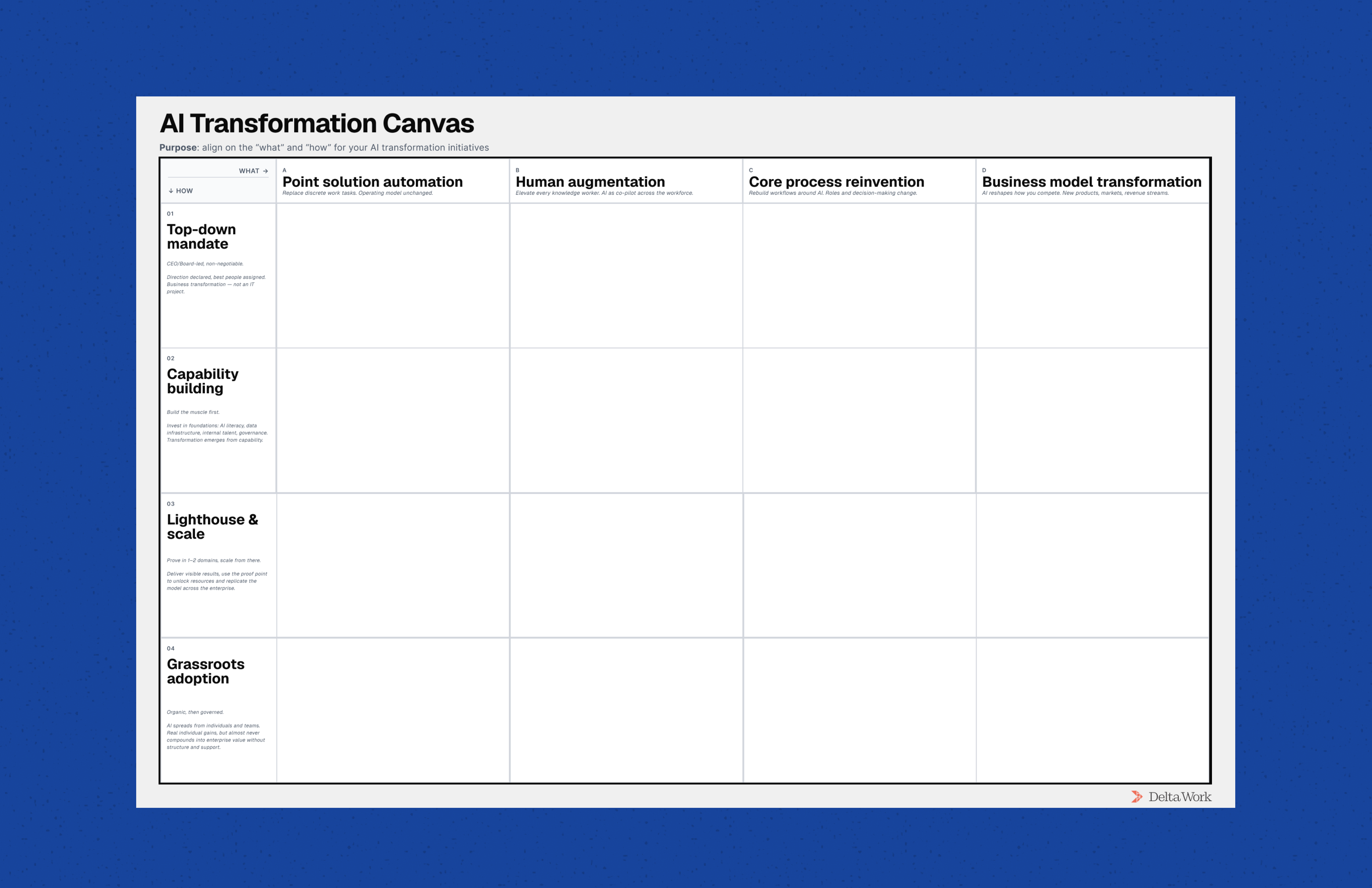
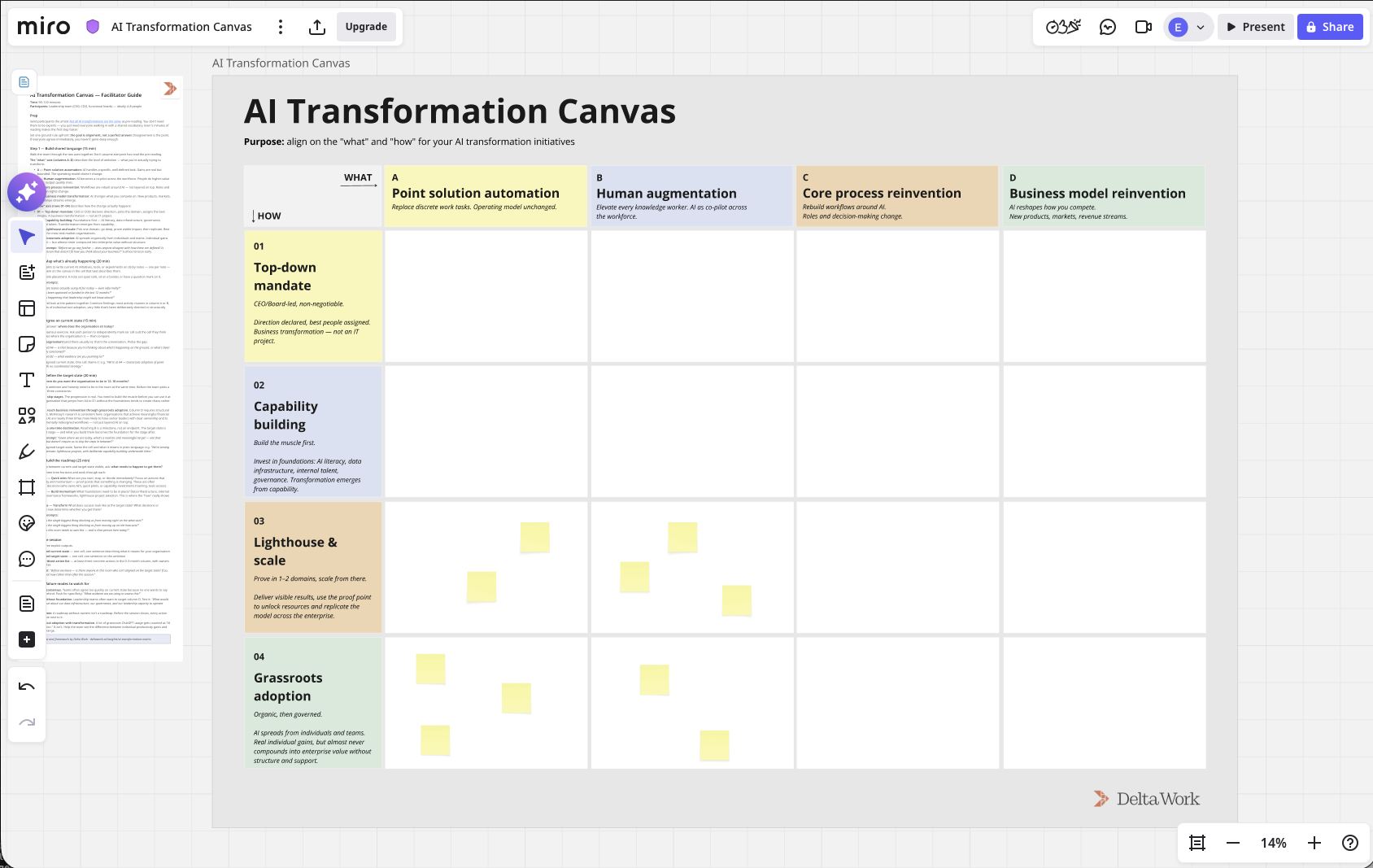
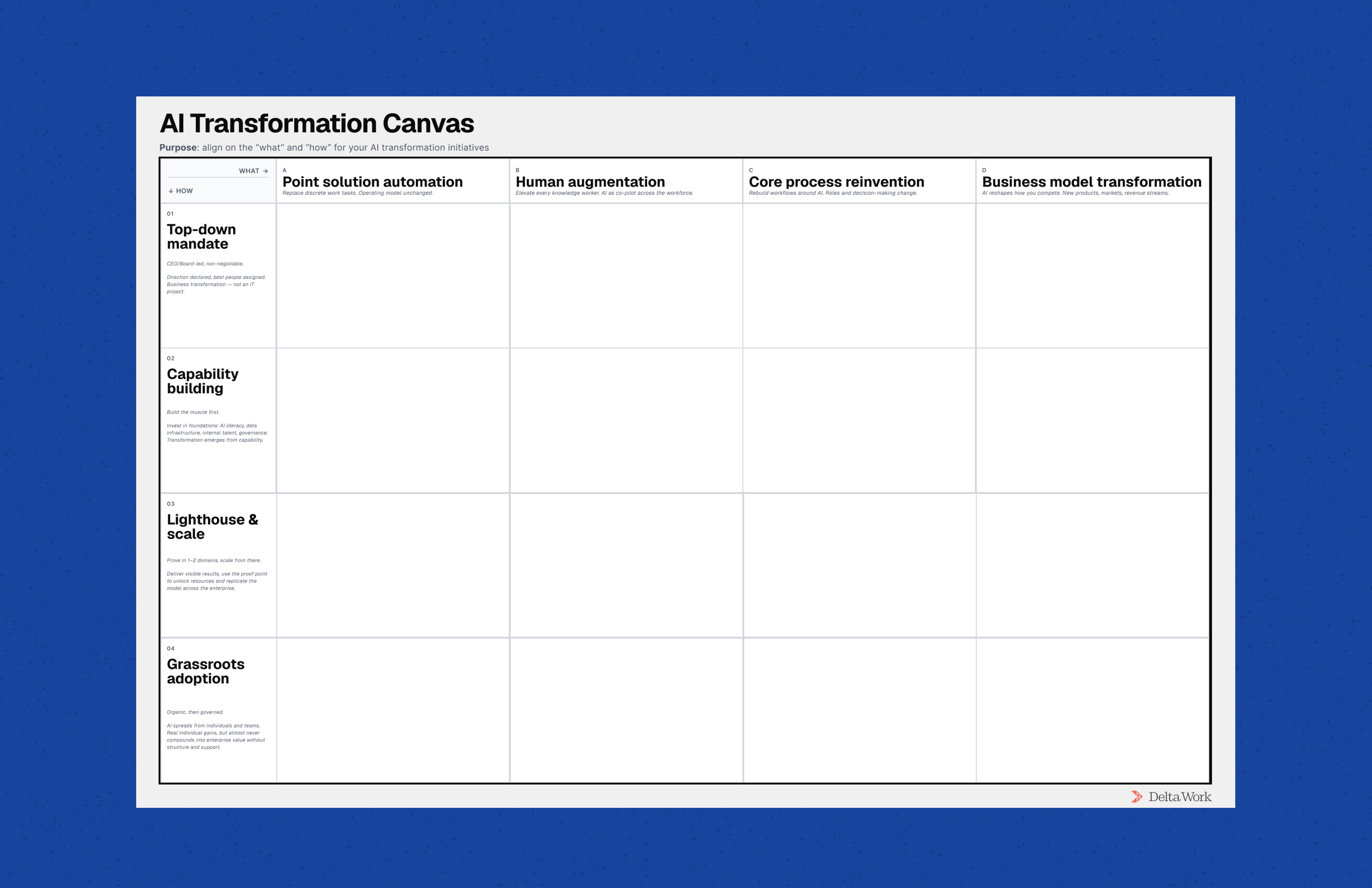
The canvas maps two dimensions. The first is what you're transforming — the level of ambition, from replacing discrete tasks with AI all the way to reshaping your business model. The second is how you plan to make that change happen — from a CEO-led mandate to organic grassroots adoption.
Together they form a 4×4 matrix. Each cell represents a combination of ambition and approach. Your job as a leadership team is to locate where you are, agree on where you're going, and be honest about what it will take to close the gap.
Want to go deeper on the framework? Read the full article: Not all AI transformations are the same →
How to run it
The canvas is designed to be run by your leadership team without a facilitator. Everything you need is on this page. If you'd prefer Delta Work to run it for you, we can do that too.
- Before the session
- Send participants the AI Transformation Matrix article as pre-reading
- You don't need everyone to be an expert — you just need a shared vocabulary in the room
- Set one ground rule upfront: the goal is alignment, not a perfect answer
- If everyone agrees immediately, you haven't gone deep enough
- Step 1 — Build shared language 15 min
- Walk through the two axes together — don't assume everyone has done the pre-reading
- The goal isn't agreement yet — it's making sure everyone is working from the same definitions
- Surface any assumptions or tensions early; they'll matter later
- Step 2 — Map what's already happening 20 min
- Add current AI initiatives, tools, and experiments to the relevant cells — one sticky note per initiative
- Step back and look at the pattern together
- Most organisations find activity clustered in column A or B, row 04: lots of individual tool adoption, very little that's been deliberately directed
- That pattern is the conversation starter
- Step 3 — Agree on current state 15 min
- Land on one cell that best describes where the organisation sits today
- Ask each person to call their answer independently before comparing
- Disagreement is normal — and useful
- Probe the gap: are people describing what's officially sanctioned, or what's actually happening on the ground?
- Step 4 — Define the target state 20 min
- Agree on where you want to be in 12–18 months
- Name the constraints first: you can't skip stages, and you can't reach business model transformation through grassroots adoption alone
- Structural reinvention requires structural commitment
- Be honest about what you're actually ready to invest in
- Step 5 — Build the roadmap 25 min
- Identify what needs to happen across three horizons: quick wins (0–90 days), foundations (months 3–6), structural moves (months 6–12)
- Every action needs an owner before you leave the room
- A roadmap without owners isn't a roadmap