
Not all AI “transformations” look the same.
Most leadership teams I meet are already determined that AI transformation is a priority. Whether it’s pressure from their board, or their CEO/CIO, they all know they need to drive adoption of AI in their business.
The question they can't answer, at least not as a team, is what exactly they're trying to transform, and how they expect that change to actually happen.
That gap matters more than people realise.
I've seen leadership teams spend weeks debating AI strategy without ever realising they were describing completely different destinations. One executive is thinking about automating a handful of operational tasks. Another is imagining rebuilding entire workflows with agents. A third is quietly hoping to use AI to enter new markets entirely.
The two questions every leadership team needs to align on
When I work with leadership teams on AI strategy, I focus on two dimensions: The first is what you're transforming. The second is how you plan to make the change happen.
Let’s go through each dimension on its own before putting them together for the bigger picture.
The "what": four levels of AI ambition
Not all AI initiatives are intending to achieve the same things. There's a meaningful spectrum, and where you're aiming has significant implications for how much investment, change management, and leadership commitment is actually required.
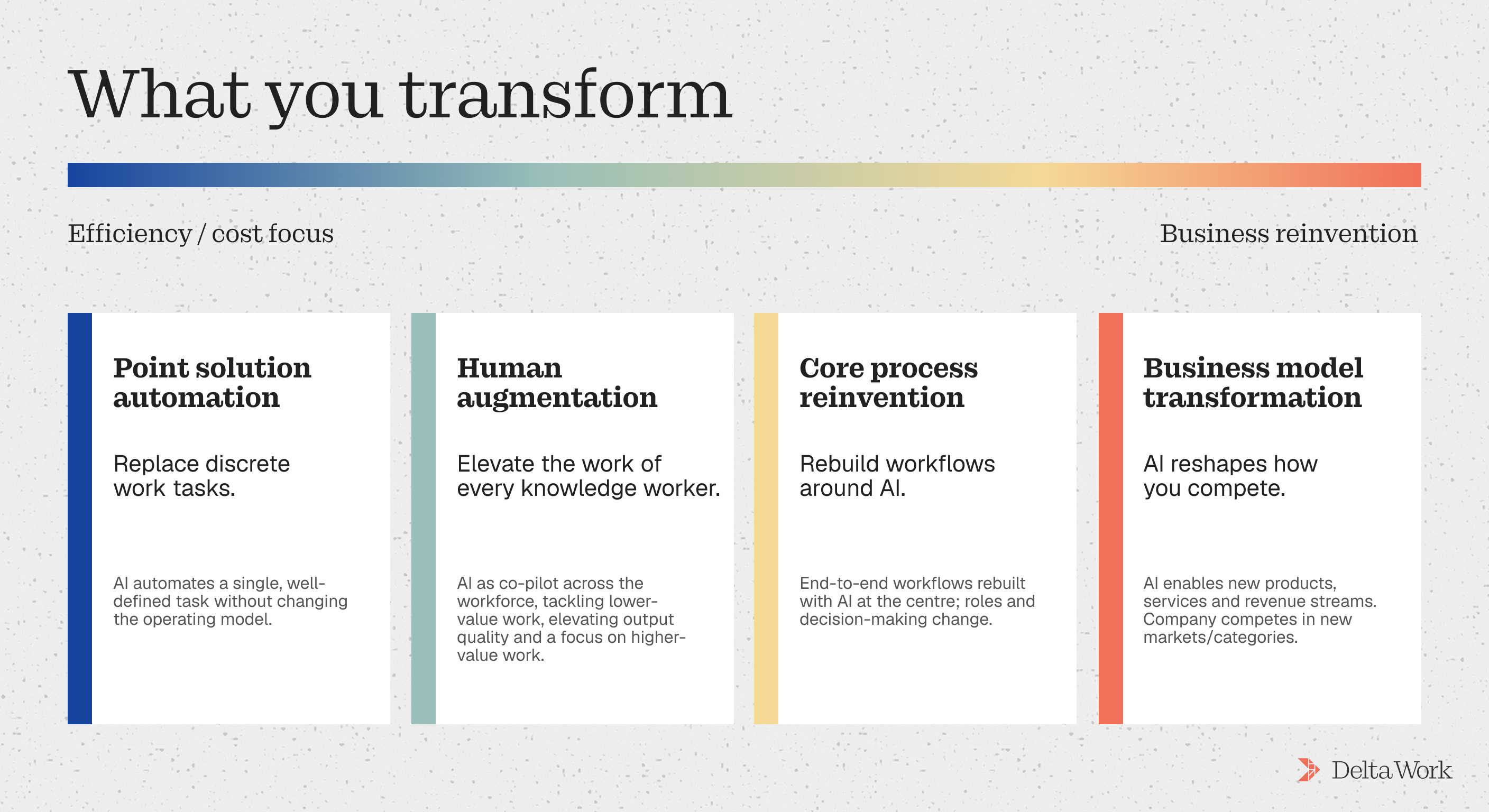
Point solution automation is where most companies start: AI handles a specific, well-defined task. For knowledge workers, that could look like writing first drafts, summarising meeting notes, processing documents. The gains are real but bounded.
Human augmentation is a step up in ambition. AI becomes a co-pilot across the workforce, tackling lower-value work, elevating output quality, and freeing people to focus on the work that actually requires human judgment.
Telstra's recent AI deployment is a good example of what this looks like in the real world: what started as a 300-person Copilot trial expanded to 21,000 employees (Australia's largest Microsoft 365 Copilot deployment) already saving one to two hours per person per week, with 90% of staff reporting it improved their experience at work. That's not a point solution. That's a deliberate, enterprise-wide investment in workforce capability.1
Core process reinvention means rebuilding workflows around AI. Workflows are fundamentally redesigned; AI isn’t just sprinkled on top. How the work actually gets done is different. Roles change. Decision rights shift.
Suncorp's AI program has automatically generated over a million words in claims case summaries and saved more than 14,000 staff hours through its Smart Knowledge tool. Single View of Claim, running on Suncorp's internal AI platform SunGPT, consolidates case notes, documents and communications into a unified summary for approximately 1,500 claims staff, cutting per-claim review time by five to thirty minutes. That's not a productivity tool layered on top of an old process. That's the process being redesigned. 2
Business model transformation is the rarest and most demanding level. This is where AI doesn't just improve how you do things. It changes where you compete, through new products, services and entries into new markets.
Atlassian’s acquisition of The Browser Company (maker of the Dia and Arc browsers) for $610 million signals a bold bet to move the application layer into the browser itself.¹ The rationale is strategic, not opportunistic: 85% of enterprise workflows occur within web browsers, yet browsers were built for consumers, not knowledge workers. The thesis is that the browser, not the individual SaaS app, is where AI context, memory and action will converge for knowledge workers. For a company whose tools already run inside those tabs, owning the layer underneath is a bet on where AI-native enterprise value will actually be created in the future.3
The "how": four change approaches
AI ambition is one thing. Change approach is another. This is where I see the most misalignment.
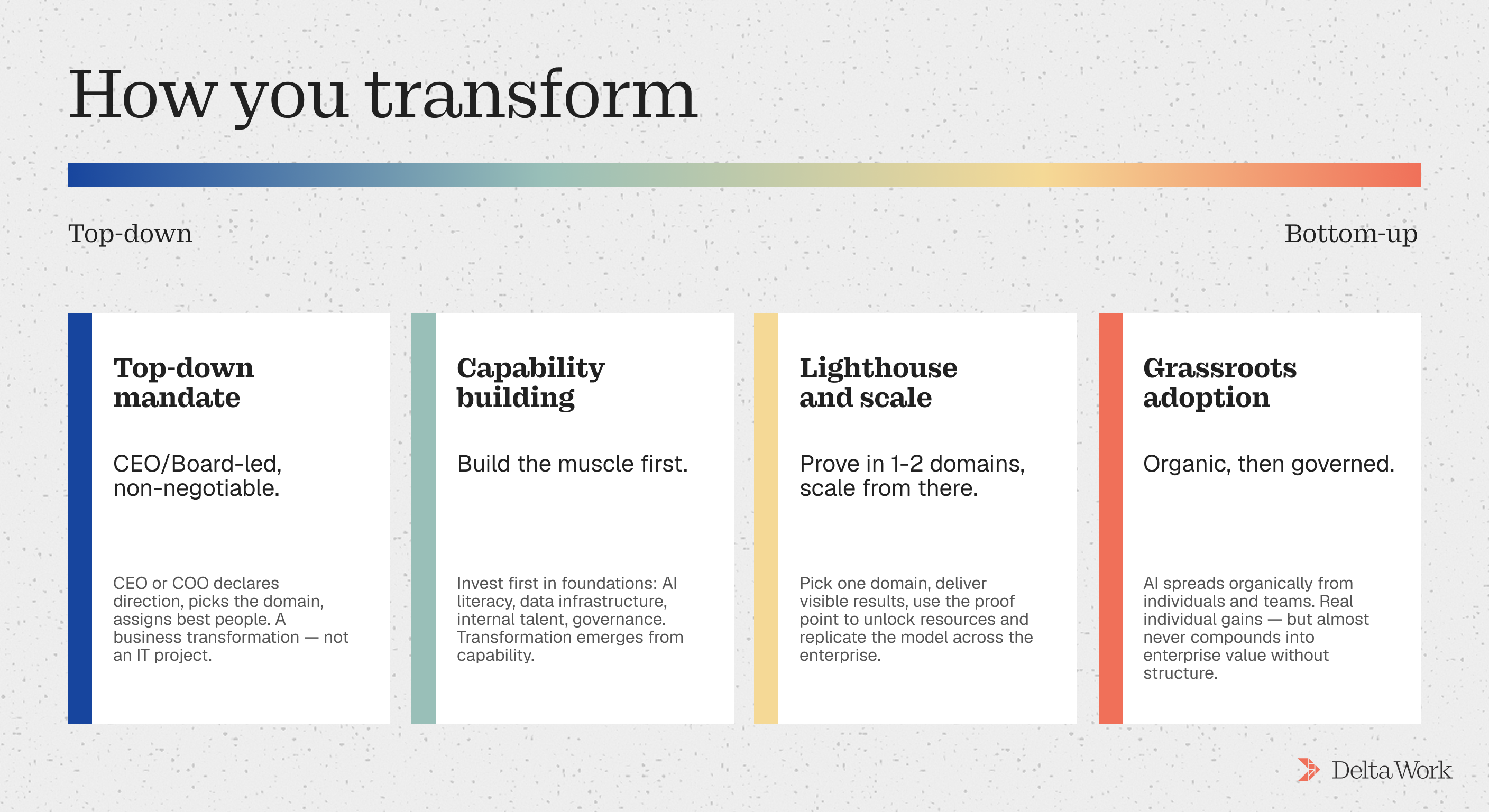
Grassroots adoption is where most Australian companies actually are right now. AI spreads organically from individuals and teams doing their own thing: buying their own tools, building their own prompts, finding their own shortcuts. The individual gains are real. The problem is that they rarely compound into enterprise value.
BCG's research is clear: 74% of companies struggle to achieve and scale value from AI, and the leaders who do consistently focus 70% of their effort on people and processes, not technology. Grassroots adoption is a valid starting point. It's not the destination.
Lighthouse and scale is where I see the best return for most mid-market organisations. Pick one domain. Go deep. Prove visible impact. Use that proof point to unlock resources and replicate the model.
Capability building is a longer game. The focus is on building foundations first: AI fluency, data infrastructure, governance, internal talent. Transformation emerges from the capability you build, rather than being declared from the top.
Top-down mandate is exactly what it sounds like: the CEO or COO declares direction, picks the domain, and assigns the organisation's best people to the transformation. For a very heavy-handed approach, you can look at Meta’s workforce AI transformation.
Putting it together: the AI Transformation Matrix
The AI transformation matrix maps these two dimensions together. Each cell represents a combination of ambition and approach. Some are natural fits, some are viable with the right conditions, and a few are genuinely difficult or rare.
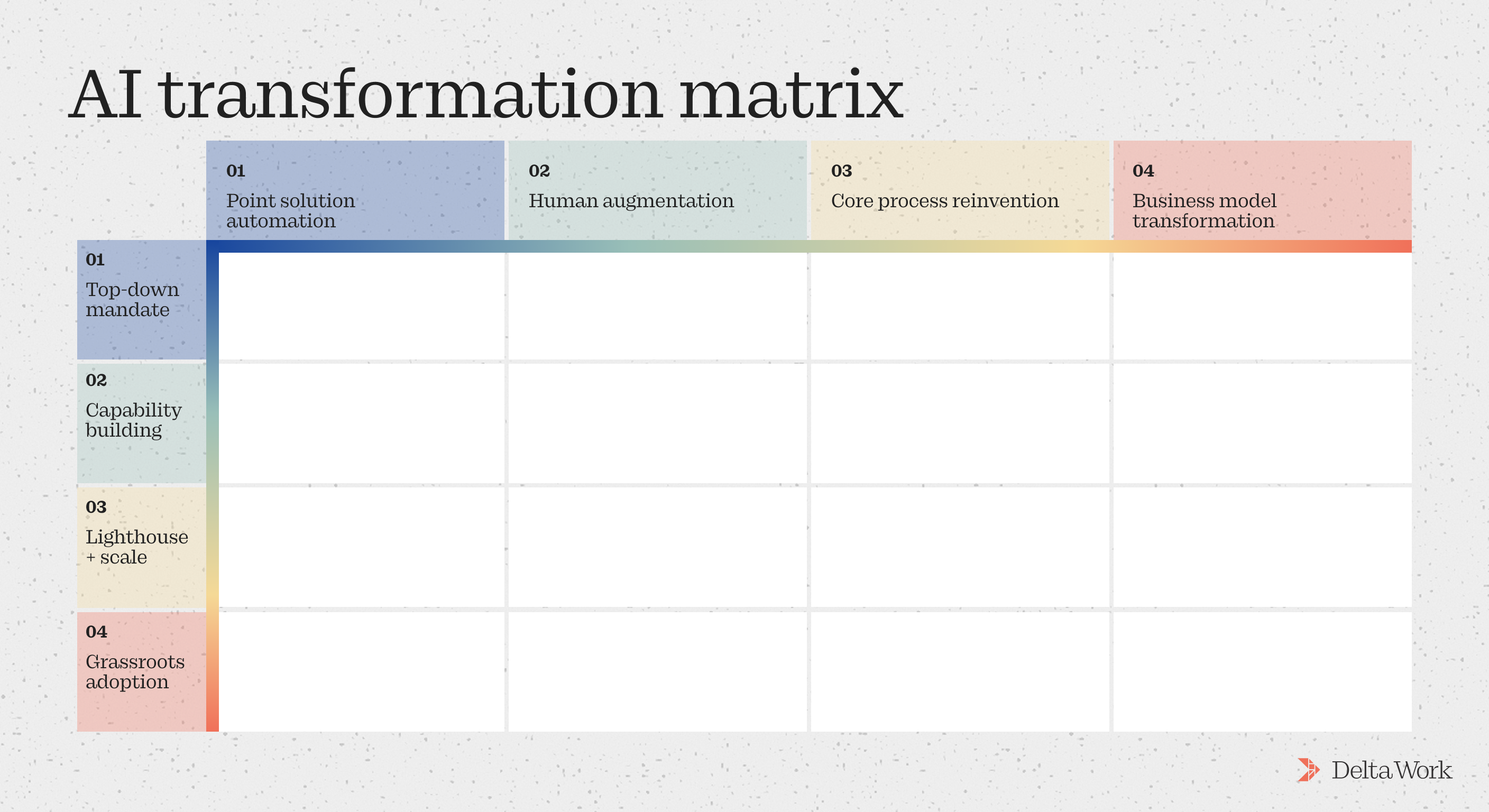
Most mid-sized Australian organisations land in the bottom-left: grassroots adoption, point solution focus. Real wins, but no compounding impact. The next step is where you go from there to meet your company’s ambition, strategy and capability.
How to use this matrix
There's no universally correct position on this grid. The right combination depends on where your organisation is today, what your risk profile looks like, and how much genuine leadership capacity and capability you have to drive change.
But there are some things you can't do, regardless of ambition or resources:
You can't skip steps.
Organisations that jump straight to business model transformation without the capability foundation tend to create chaos rather than value. The progression is real: you need to build the muscle before you can use it at scale.
This isn't a one-time destination.
Reaching workforce augmentation is a milestone, not an endpoint. The organisations compounding their AI advantage are treating each stage as a foundation for the next.
You can't get to business reinvention through a purely bottoms-up approach.
McKinsey's research is clear: nearly two-thirds of organisations are still stuck in pilot or experiment mode, and only 6% achieve meaningful financial impact from AI.4
The gap almost always comes back to the same two factors: leadership alignment and workflow redesign. High-performing organisations are nearly three times more likely to have senior leaders demonstrating clear ownership and long-term commitment to AI, and nearly three times more likely to have fundamentally redesigned workflows rather than layering AI on top of old processes.
Grassroots adoption produces individual wins. Structural reinvention requires structural commitment.
Strong, fluent leadership isn't optional.
Real and sustainable change demands leaders who aren’t just enthusiastic about AI, but leaders who genuinely understand what AI can and can't do, and are willing to make the hard calls about where to focus and where not to. That's rarer (and harder) than it sounds.
Start with the conversation, not the tactics
If you take one thing from this framework, it's that the matrix is most useful before you build a strategy, not after.
Use it to surface where your leadership team actually agrees or disagrees:
- Where are our teams today? Where are the pockets of early wins and experiments in the organisation?
- Where do we want to be in the next 6-12 months based on our strategic priorities, current capabilities and constraints?
- What investments are currently in flight and what's the gap between those investments and the ambition we have?
The goal isn't to make it to the upper-right corner. It's to get the leadership team genuinely aligned on what you're building toward and how you plan to get there.
Telstra and Microsoft, "Telstra and Microsoft expand strategic partnership to power Australia's AI future," Microsoft Australia News Centre, August 2024. https://news.microsoft.com/en-au/features/telstra-and-microsoft-expand-strategic-partnership-to-power-australias-ai-future/
Suncorp Group, "FY25 Tech Milestones," Suncorp Group News, 2025. https://www.suncorpgroup.com.au/news/news/fy25-tech-milestones-suncorp
Atlassian Corporation, "Atlassian Enters Into Definitive Agreement to Acquire The Browser Company of New York," Business Wire, September 4, 2025. https://www.businesswire.com/news/home/20250904645125/en/Atlassian-Enters-Into-Definitive-Agreement-to-Acquire-The-Browser-Company-of-New-York. Acquisition completed October 21, 2025: https://www.businesswire.com/news/home/20251021473486/en/Atlassian-Completes-Acquisition-of-The-Browser-Company-of-New-York
McKinsey & Company, The State of AI in 2025, 2025. Key findings: 88% of organisations use AI in at least one function; nearly two-thirds remain in experiment or pilot mode; only ~6% qualify as high performers (>5% EBIT impact from AI). High performers are ~3x more likely to report senior leadership ownership of AI and ~3x more likely to have fundamentally redesigned workflows. https://www.mckinsey.com/capabilities/quantumblack/our-insights/the-state-of-ai