Most mid-sized companies have bought AI tools. Few have changed the way they work.
Deloitte's latest research found that only 34% of organisations are using AI to deeply transform how they work. 1 Atlassian puts it starker: just 14% of teams have cracked the AI ROI code. 2 The gap between AI investment and AI impact is already wide, and it's growing.
AI transformation isn't a tech problem (the tools work), it's a people problem.
How AI became IT's problem by default
For mid-sized companies without a Chief AI Officer, a dedicated transformation function, or a clear mandate, AI usually lands where technology lands. It goes to IT, operations, or whoever raised their hand first.
Somehow, managing the tools became owning the transformation.
The National AI Centre found that while 43% of Australian businesses report some level of AI adoption, most haven't changed the underlying workflows that drive how work actually gets done. 3 As one exec put it recently: "our AI adoption is pretty much limited to our people looking up horoscopes and footy tips." That is not transformation.
The gap isn't technical. What's missing are the critical decisions that sit upstream of the tools: how roles need to change, how team composition should evolve, how capability gets built.
What AI transformation actually demands of the workforce
AI isn't just changing what tools people use. It's changing the nature of work itself.
Atlassian's State of Teams research found that 55% of executives say AI is widening performance gaps between teams (not between companies, between teams within the same organisation). 4
At the organisational level, this creates decisions that have nothing to do with technology:
- Which roles need to be redesigned as AI takes on workflow components?
- Which team structures made sense before AI but create bottlenecks now?
- How do you coordinate work when humans and AI agents are operating alongside each other?
These aren't IT questions. They're organisational design questions, and in most mid-sized companies, nobody is asking them.
Which brings us to the specific work that falls squarely in HR's remit:
- Workforce planning under uncertainty. Roles that looked stable two years ago are being partially automated today. HR needs to be mapping which roles are most exposed, which will evolve, and which new roles the organisation will need.
- Role evolution at the team level. As AI takes on repeatable knowledge and office work, the human part of every role shifts toward judgment, relationships, and coordination.
- Capability building that operates collectively. Most AI training programs build individual fluency. But if only one person on a team knows how to use AI well, the benefits don't compound to the team, it just creates new dependencies.
- Change management for people whose work is shifting. Research shows that 80% of employees at mid-sized Australian companies are concerned about losing competitive advantage without AI adoption. 5
This work exists whether HR or Heads of People claim it or not.
Why the door is open for HR to lead now
The people closest to the technology, IT and Operations, don't have the mandate or the skillset to fix it.
That's not a technology problem. It's an organisational problem. And it has created a genuine opening for HR.
The conditions that determine whether AI actually embeds are all HR levers: team structures, role composition, collective capability, governance norms, psychological safety, leadership capability. Nobody else in the organisation owns them. And right now, most of them are sitting untouched.
Most HR leaders already have exactly what this moment demands: the ability to design organisations, build capability, sequence change, and move people through uncertainty. The only thing that needs to shift is the focus and mindset.
Creating the shift for HR
Here's where it gets practical.
The AI Transformation Framework has five core components: Strategy, Governance, Capability, Tooling, and a PDCA operating rhythm at the centre. It's a useful lens because it makes visible what's often invisible: the full scope of what transformation actually requires, and who needs to own what.
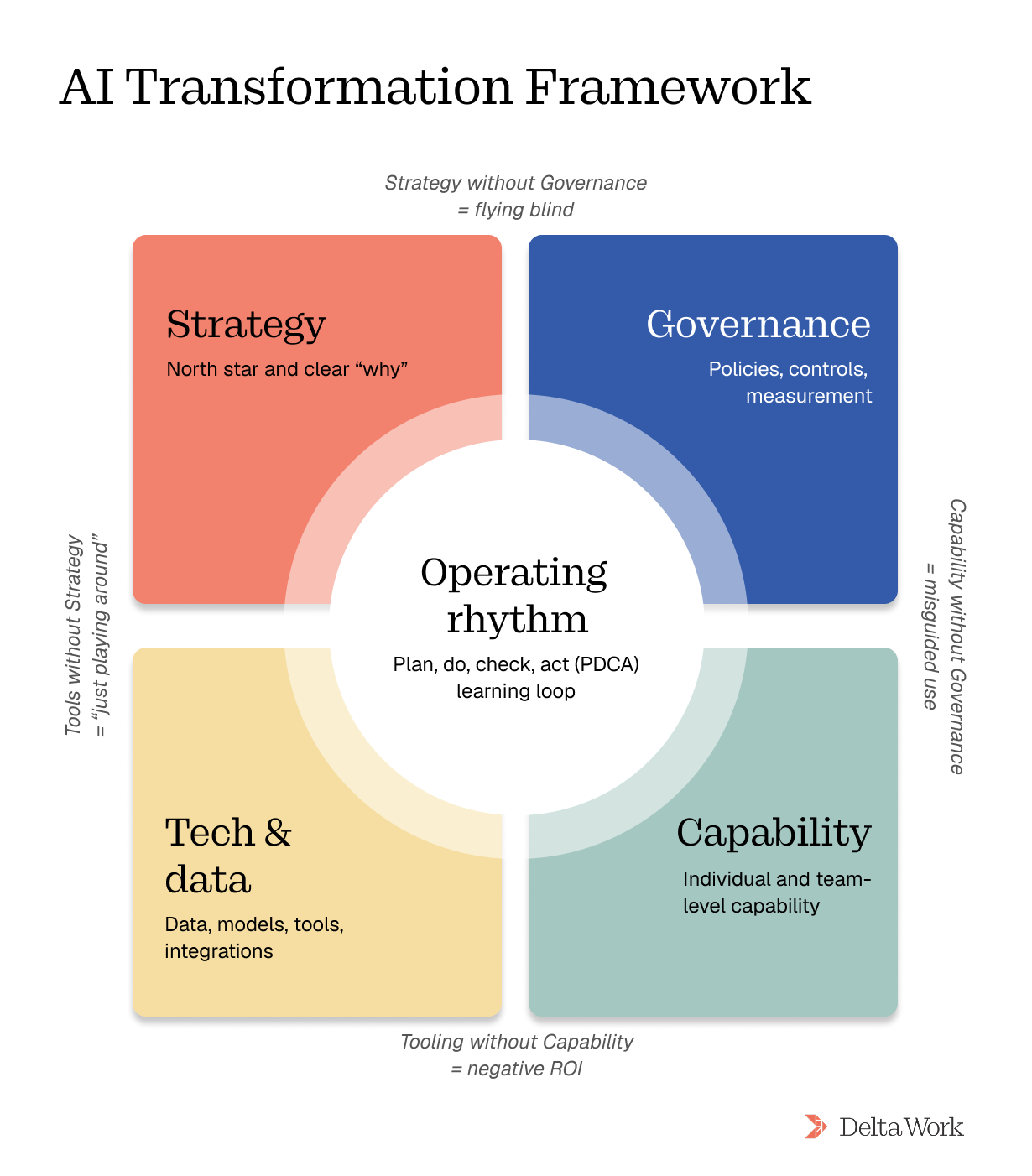
Tooling belongs to Operations and IT. The decisions about which models, tools, and integrations the organisation deploys are technical decisions. Leave them there.
Everything else has people decisions at its core.
Strategy isn't just a technology roadmap. A complete AI strategy includes the workforce lens: which roles will change, how capability will be sequenced, what the organisation needs to look like on the other side of transformation.
Without that component, you don't have a strategy. You have a procurement plan.
Role of HR: Ensure the people architecture is defined before the technology decisions are locked.
Governance is typically treated as an IT and compliance problem: data controls, guardrails, risk management.
The people side of governance is just as consequential: how AI decisions get made at the team level, what norms govern use, and whether the culture creates enough psychological safety to raise concerns.
Role of HR: Own the human side of governance — the norms, the trust mechanisms, and the accountability structures that determine whether AI gets used well.
Capability is the most obvious HR domain, but only if it's defined correctly.
Individual AI training is not enough. If one person on a team is highly fluent and the rest aren't, you haven't built capability. You've built a dependency.
Role of HR: Design for collective fluency — build shared ways of working at the team level, not just individual skills.
The PDCA rhythm — plan, do, check, act — is the operating heartbeat of continuous improvement.
Role of HR: Own the learning loop, the cadence of reflection and adaptation that turns isolated activity into organisation-wide change.
Tooling — models, tools, integrations, infrastructure. Leave this here. It’s the one component that doesn’t have a people decision at its core.
The two-engine model
In most mid-sized companies, you have a Director of Operations and a Director of HR (or People). Between them, they should hold almost everything that determines whether AI transformation succeeds or fails.
AI transformation in this context is fundamentally a two-engine model:
- *Operations owns the “what”:* the workflows, the process redesign, the tooling decisions, the productivity outcomes, the measurement of whether any of this is actually working.
- *HR owns the “who” and “how”:* the capability building, the org design, the change sequencing, the governance norms, the conditions that determine whether people move with transformation or around it.
Neither engine alone gets the aircraft off the ground.
When Operations drives AI transformation without HR, you get tool deployment without behaviour change. A few individuals figure it out on their own. Everyone else stays in the status quo.
When HR drives AI transformation without Operations, you get programs without process change. Capability gets built in a vacuum with nowhere to land.
Your next 90 days
The first move is to get into the conversation and then actively shape it.
Here's a practical way to think about the next 90 days.
- Map which teams are actively using AI and which aren't; the real picture, not the official one
- Identify what tool and technology decisions have already been made without HR in the room
- Talk to team leaders about where they're feeling the pressure: workflow changes, role uncertainty, capability gaps
- Form a clear point of view on where the biggest people risks are sitting right now
- Schedule a leadership session specifically focused on AI transformation. Not a tool demo, not a budget conversation
- Use the AI Transformation Canvas to structure the session: where are we, where are we going, and who owns what
- Make the ownership question explicit: which components belong to Operations, which belong to HR, and where the joint accountability sits
- Leave the session with a shared definition of what success looks like and who is accountable for what
- Set a regular cadence (monthly or quarterly) for HR and Operations to review progress together
- Build a feedback mechanism that connects capability building back to real workflow change
- Identify one or two team-level pilots where HR and Operations can co-own the transformation work end-to-end
- Make the learning loop visible: what's working, what isn't, and what needs to change
Ninety days won't complete your AI transformation. But it will establish HR as a serious co-owner in it, which is the prerequisite for everything else.
The time is now
The case for HR isn't that you deserve a seat at the table. It's that the work that determines whether AI transformation succeeds or fails is already yours: the workforce design, the capability building, the change sequencing, the governance norms.
That's HR’s new role and now's the time to own it.
[1]: Deloitte AI Institute, State of AI in the Enterprise 2026 — deloitte.com
[2]: Atlassian Teamwork Lab, State of Teams 2026 — atlassian.com
[3]: National AI Centre, SME AI Pulse: December 2025 – February 2026 — ai.gov.au
[4]: Atlassian Teamwork Lab, State of Teams 2026 — atlassian.com
[5]: Avanade, Seeking AI returns: Pathways for mid-market organisations in 2025, Consultancy.com.au, February 2025 — consultancy.com.au