Nearly four years after the arrival of ChatGPT 3, most executive leaders are scratching their heads and asking the same question: what value is AI actually bringing to our organisation?
Nearly 9 in 10 organisations now use AI regularly, yet only 37% can point to any impact on their earnings.[^1]
That number hasn't moved in a year.
Drawing on my experience in org design, ways of working and human-AI teamwork, this is my current view of what's happening today and the way forward.
The promise and the reality
One of the things I love most about running my own consultancy is the chance to speak with a lot of different companies.
Across all of those conversations, one pattern keeps showing up. Most companies are investing heavily in the individual side of AI. They're buying licences, rolling out individualised upskilling programs and measuring individual adoption.
Why the value isn't showing up
This individualised approach hasn't produced real value across the organisation, it's just created spikes in siloed productivity.
80% of people say AI has made them more productive, but in the same survey, enterprise-level impact stayed flat.[^2]
Without meaning to, companies are optimising for individuals, not for the organisation as a whole.
In practice, most employees now work as an org chart of one. It's each individual employee, working with their AI. They feed it the limited context they have access to. They've figured out their own workflows, and some have even built their own skills. All the while, their team's ways of working haven't changed. If anything, they've got a lot worse.
AI slop is proliferating: 41% of workers had received low-quality AI work from a colleague in the past month, and 42% trusted the sender less afterwards.[^3]
Some teammates are off to the races, but they keep getting held back by the same things: slow decision making, legacy governance checks, poor handoffs, and duplicated (and often unnecessary) work.
The reality is that value isn't delivered by individuals alone, it takes teams: groups of people with diverse skillsets, working together towards an outcome. Microsoft's research across 20,000 AI users backs this up. Organisational factors like culture, manager support and talent practices account for more than twice the AI impact of individual factors.[^6]
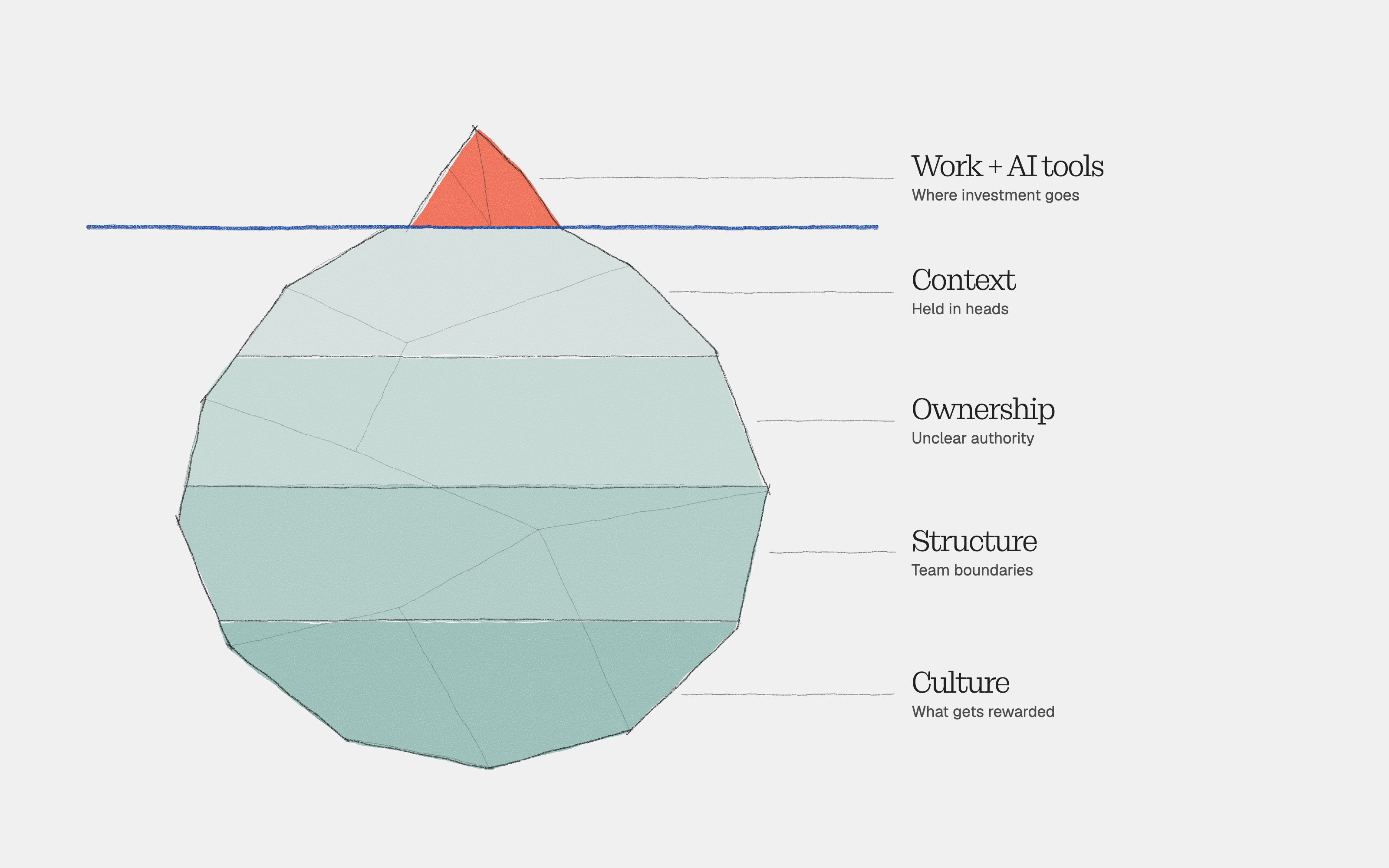
Organisations are optimising for the sliver they can see right in front of them: the work, with AI tools sprinkled on top. The real value, and any impactful transformation, comes from what's underneath.
Why should organisations care now?
I often describe AI as a Trojan Horse.
It has arrived like a gift from the gods. Beautiful, powerful and shiny, sitting right there on the beach, ready for us to bring inside our walls.
But the real benefit isn't the horse, it's what's inside it.
AI is forcing organisations to finally address the ways of working challenges we've put up with for years, and in many cases decades.
Humans are great at dealing with fuzziness, incomplete context, and unclear roles and responsibilities. AI isn't.
Before AI, organisational debt was a slow-burning tax that everyone had grown comfortable with, and employees paid most of it. With AI, companies will find it's a hard ceiling on their potential, and on their ability to see a positive return on the AI they've brought in.
Peeling back the layers
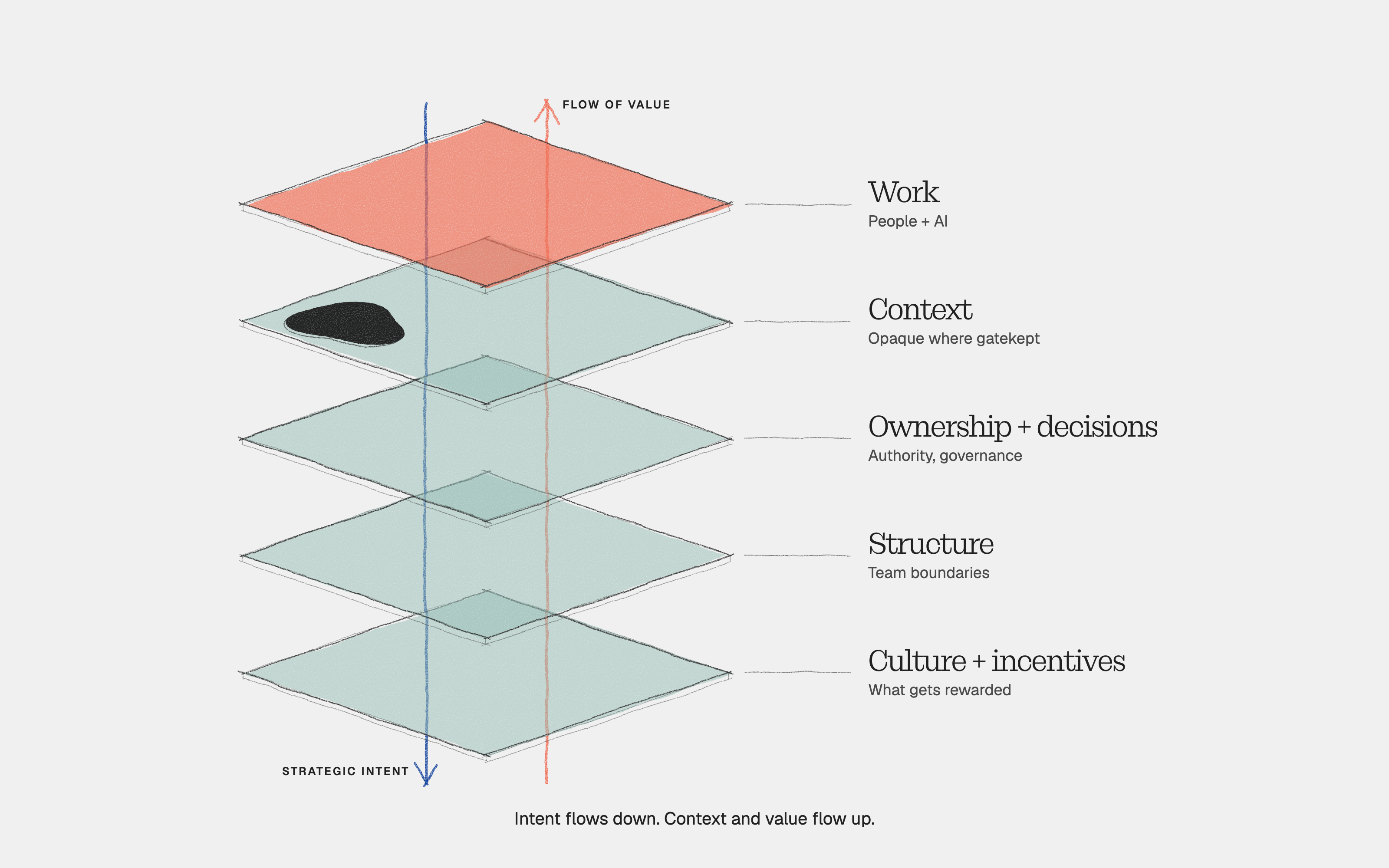
I think about this as a set of transparent layers sitting on top of each other, with information and value flowing through them.
Intent flows down, from leadership to the work. Context and value flow up, from the work to the business and its customers.
When value isn't flowing, it's usually one of two failure modes. The first is opacity: a layer that information can't pass through, because context is gatekept, undocumented or held by one person. The second is misalignment: layers that don't line up, so work hits a wall.
Starting with the sliver everyone can see, here's what each layer looks like, and where it tends to break.
Starting with the sliver most organisations are obsessed with, here's what each layer looks like, and where it tends to break.
Layer one: The work
At the top is the work itself, done by people and AI together.
This is the sliver most AI investment goes into, and it's where the org chart of one lives. Individuals move faster, then hit the same bottlenecks as everyone else: more output to review, with the same capacity to review it.
🤔
When one person gets faster, does the team's work actually move faster?
Layer two: Context
Next comes context: whether knowledge is captured, accessible, machine readable and efficient, or stuck in someone's head.
Everyone's AI learning journey eventually arrives at the same realisation: AI is only as good as the context it has access to.
In most organisations, context is limited at best. It's held in individuals' heads, and it's gatekept as a form of currency to curry political favour. The higher up you go, the more information you acquire, and that information is real power to make things happen.
A senior executive I've worked with at a major bank describes it like this:
"I spend most of my time buying people coffees to answer the same questions: who's doing what, what do they care about, and how can we move things forward."
People are doing their jobs as best they can, with the limited context they have access to. AI doesn't fix that. It only makes the problems worse. Give people AI and they produce more work, faster, with more confidence, on the same partial picture. The errors don't disappear, they scale.
🤔
Could a capable new hire, or an agent, do this team's core work using only what's written down?
Layer three: Ownership and decisions
Then ownership and decisions: who has authority, and how governance works.
Before AI, unclear ownership cost you a few extra meetings. Now it means AI has no reliable context to work from. Context with no clear owner goes stale, and context owned by one team but needed by five becomes a bottleneck.
Today, ownership of context falls on no one person. It's split across executive leaders, line managers, IT and other teammates, and permission is given on a need-to-know basis, one document at a time.
What needs to change is that ownership of context becomes distributed. The product owner owns the what and the why. Team leads own the how. And everyone has access to the context that they, and their AI, need to deliver better work.
🤔
For the decisions this team makes every week, is it clear who makes them, and is the reasoning written down?
Layer four: Structure
Above the foundation is structure: how teams are organised and where their boundaries sit. This is where Conway's law comes in. How your organisation is structured will shape the work it produces.
Structure decides where knowledge lives and who owns it. When team boundaries don't match how decisions are actually made, work hits a wall at every handoff. Two organisations with identical org charts can have completely different flows of context.
🤔
Do this team's boundaries match how the work actually flows, or does every piece of work need three other teams to move?
Foundation: Culture and incentives
At the base is culture and incentives: what the organisation actually rewards. Culture is the layer most organisations skip.
One company that focused a lot on culture early in its journey was one of my former employers, Atlassian. One of its long-standing values, “Open company, no bullshit” (OCNB), created a default to openness and transparency. If you've ever worked at Atlassian, you know that nothing gets done without a Confluence page: ideas, strategies and decisions put into context, available to everyone by default.
But not all organisations work this way. Only 13% of AI users say they're rewarded for reinventing how they work with AI. (Microsoft, 2026)[^6]
Access alone won't change behaviour. If holding context is what gets rewarded, people will keep the valuable stuff in their heads. Leaders need to go first. If executives keep decision rationale private, nobody below them will share theirs.
🤔
What gets someone promoted here: holding information, or sharing it?
Your org chart is throttling the value you could be delivering with AI.
To get more of that value, you need to intentionally tackle all of these layers together, as a system.
The method: slice, don't sequence
Trying to change one layer at a time across an entire organisation takes too long. By the time you've solved one layer, the other layers have already changed anyway.
The most efficient path is to slice right through every layer, a few teams at a time. It's exactly the same approach as vertical slicing in delivery.
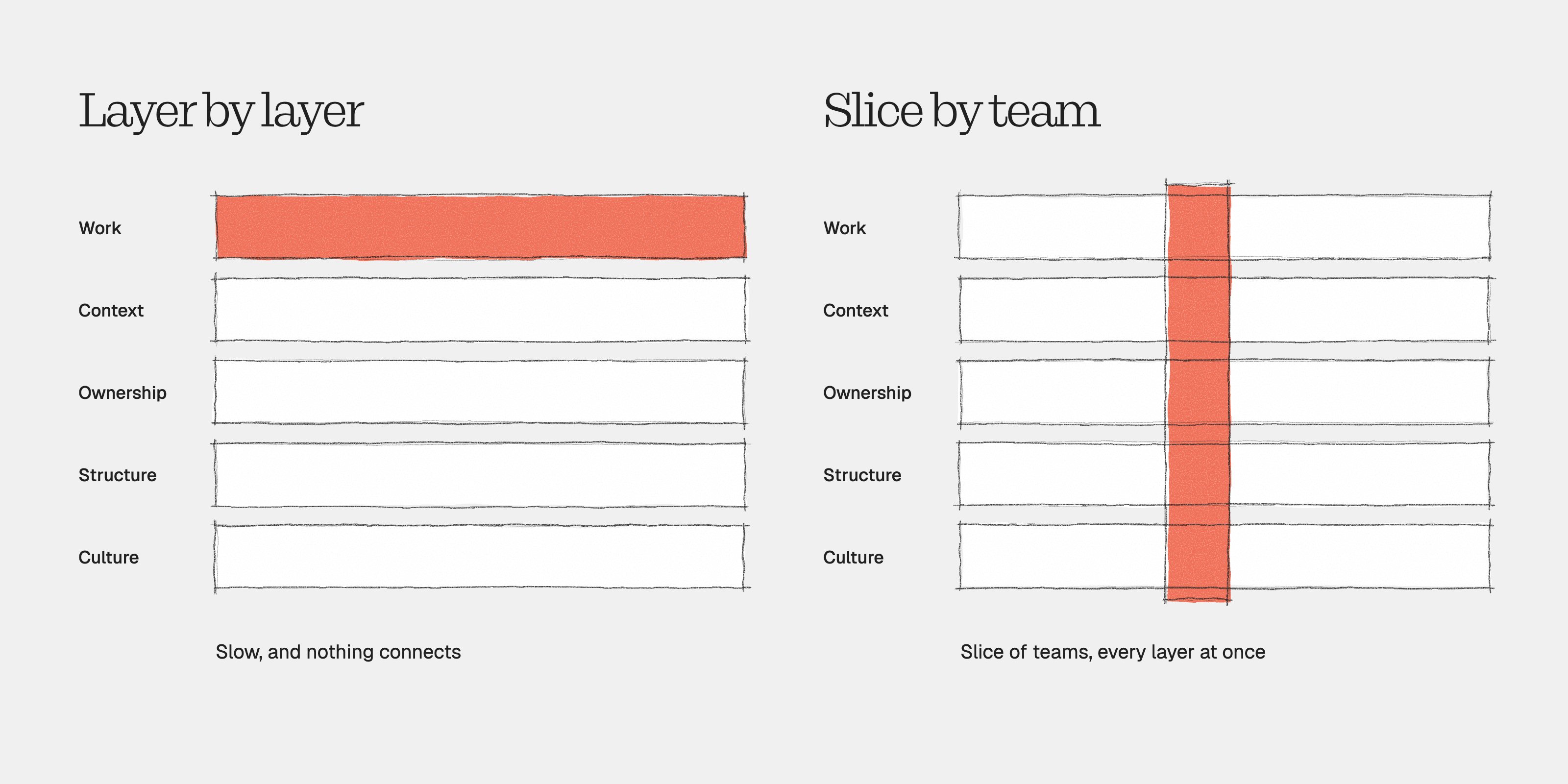
A slice is a team and its leaders, working through every layer at once: the work, the context it relies on, who owns which decisions, where the team's boundaries sit, and what behaviour gets rewarded.
The obvious risk is a slice that improves in isolation, but never spreads. So each slice needs to leave something repeatable behind, like context standards, an updated operating cadence or decision templates, so the next team moves faster than the first.
Leaders and teams, together
My approach at Delta Work is to work with leaders and teams at the same time, because both are necessary to move a team in the right direction.
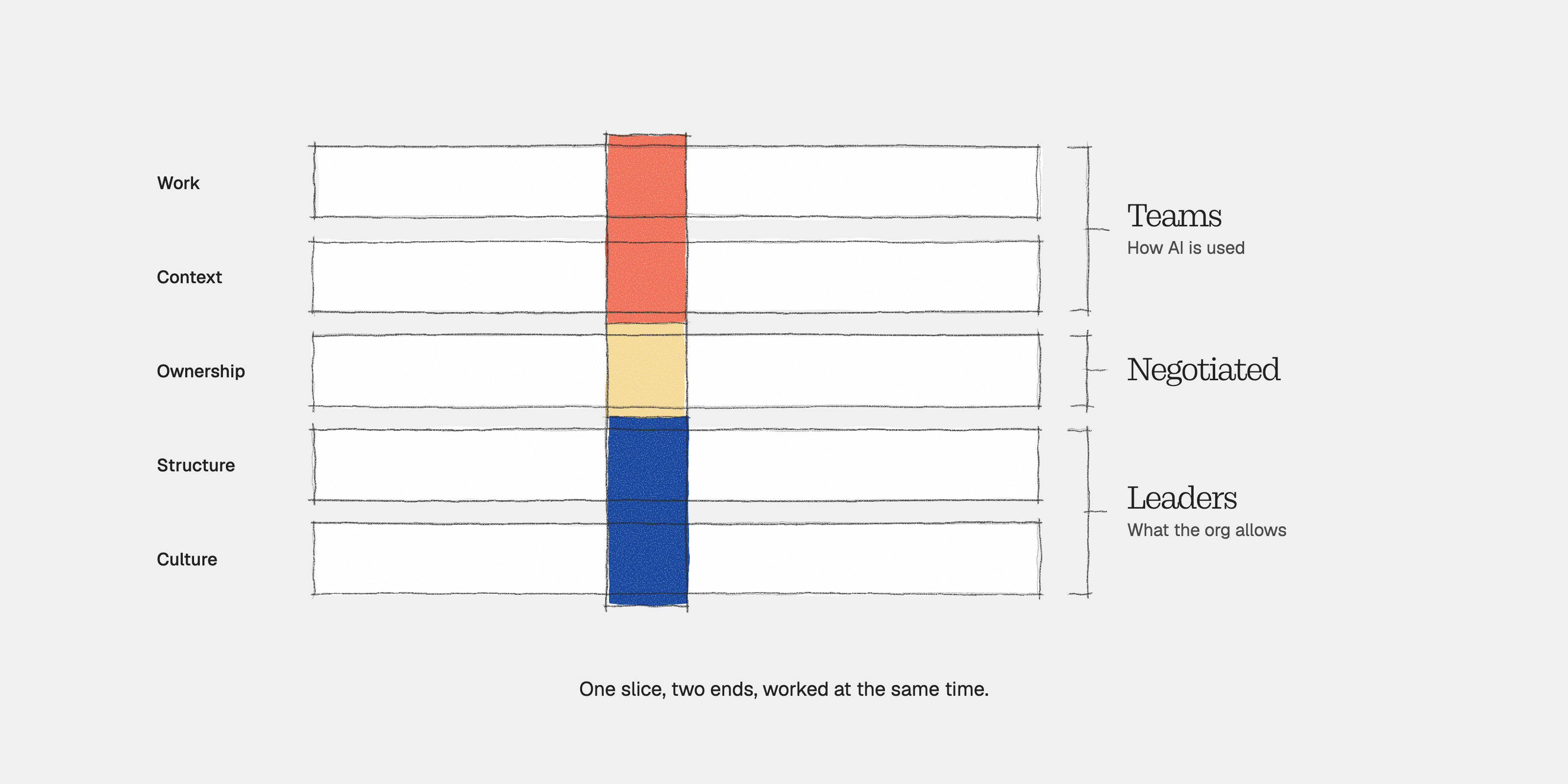
Teams own the top of the slice: the work and the context. But that should be shaped by leaders, who own the bottom: making sure the right structure, culture and incentives are in place.
Ownership and authority is negotiated between them, and that's where the real change happens.
Leaders have a role to play in fixing org-level blockers as the slice encounters them.
Enablement builds the capability, coaches teams, then steps back. It equips teams with reusable patterns to negotiate ownership and decision making, so the next team can move faster.
The next wave
The next wave of AI value won't come from more licences, better tools, or even better prompts. It comes from organisations making intentional decisions to build a more connected system: one where culture rewards sharing context, not holding it, and where teams working with AI deliver real value to the business and its customers.