On one extreme end of the spectrum of how our future could play out, there’s a vision described by AI executives that paints a picture where work becomes increasingly more agentic, automated, and isolated.
In their own words, the picture they describe sounds quite dystopian:
“AI agents are the new digital workforce…in 10 years, we will hopefully have 75,000 employees working with 7.5 million agents.” – Jensen Huang, CEO, Nvidia
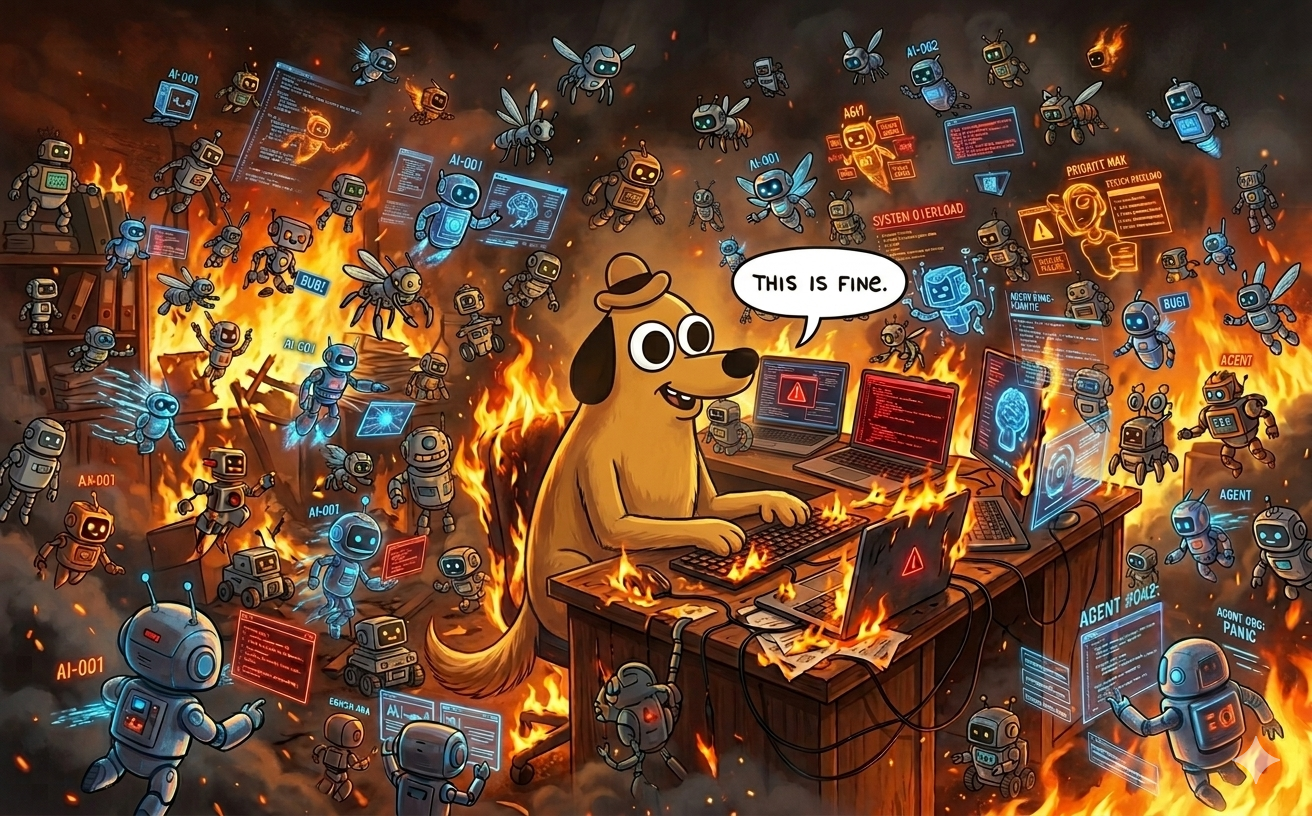
Sam Altman and Dario Amodei are making similar bets on this future. And for some reason, the idea of “future me” managing 100 virtual teammates in a big company doesn’t exactly get me excited to buy more tokens.
The problem
The extreme view of our future with AI, to me, seems like one that is optimised for technology, not for teams. And this discounts the radical power of what great teamwork can achieve.
In my conversations with execs recently, my current observation is that so much of AI productivity is on an individual level. AI tools, as they exist today, are optimised for increasing individual productivity over better teamwork and collaboration.
While we individually might feel like we're armed with new superpowers, our sense of “team” feels more chaotic and fractured.
I feel it, you feel it, and the research backs it up.
AI isn’t making us work less (as promised); it’s making us work more. It helps us work faster, but is also leading to “workload creep”: we’re taking on a broader scope of tasks, extending working hours (gotta maximise our Claude weekly usage window), roles and responsibilities are getting blurred, and it’s leading to chronic multitasking.[^1]
Low effort, AI-generated work product isn’t just flooding our LinkedIn feeds, it’s also flooding our ways of working. “Workslop” is getting passed on as original thought and while we individually feel more productive, it’s eroding team trust and slowing us down.[^2]
Finally, AI usage is eroding the critical thinking skills that we need to solve hard problems. While AI use boosts immediate task performance, it can also atrophy the capabilities we need to differentiate ourselves from AI tools: critical thinking, ability to challenge each other, patience to sit with complexity.[^3]
The takeaway: AI is making us work more, confusing roles and responsibilities, decreasing our cognitive potential, and making us trust our teammates less.
The answer to all of these problems is the same: teams that have shared practices and norms in place will be able to harvest more of the benefits of working with AI.
My mission
The main mission of Delta Work is to evolve teamwork for the age of AI, all while making sure we maintain the human connection and collaboration that makes teams capable of doing the impossible.
Delta Work is founded on a few core beliefs that underpin how we work:
Belief 1: AI “transformation” isn’t a technology problem, it’s a ways of working problem. As AI becomes a commodity, culture and collaboration will emerge as the real differentiators.
Belief 2: Change is a team sport. The most effective way is for a full team and their leaders to come together and change together.
Belief 3: The critical skill isn’t transforming once, it’s continuously evolving over time. This age of AI “transformation” is an opportunity to shed legacy ways of working, processes, and mental models that aren’t serving us anymore, but only if companies build the capability to keep adapting.
Why me
There are two main reasons why I’m starting Delta Work now.
The first reason has more to do with my own personal journey. In my 20 year career, the most meaningful and rewarding moments haven’t been about getting more work done, it’s been about building great teams.
My first moment of clarity was when I first became a manager at 26. I was working at a global advertising and media holding company when I built my first team. We didn’t have a lot of budget to hire senior people, so I essentially hired a team of interns straight out of uni. Our lack of experience turned out to be our superpower. Because no one thought they knew anything, everyone on the team was open to learn, try new things and work together.
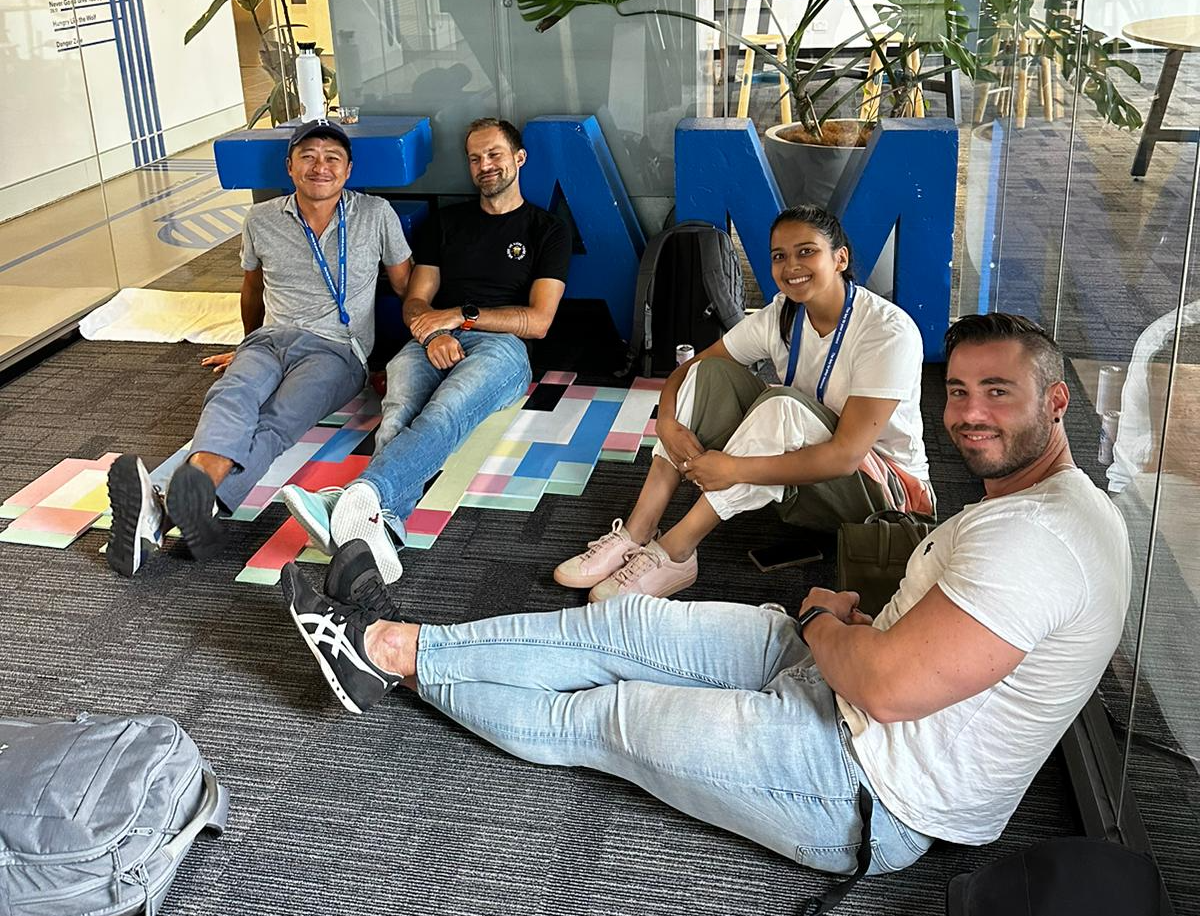
That experience then led to fifteen years of building teams across agencies, startups, big tech and consulting firms - each one teaching me something different about what makes teamwork work. It’s brought me the greatest joys of my career: seeing your teammates do things they never thought they could; solving a really complex problem; bringing a once-fractured team together and seeing them build momentum; supporting others through heartbreak and loss (pictured: my all-time favourite team from Atlassian, who are still among my dearest friends).
The second reason is that there are only a handful of others who are focusing on this aspect of AI. On one hand, there are plenty of consultancies who are promising shiny pitch decks to “transform” with AI. On the other, there is an ever growing number of AI software. But in trying to find companies who focused on evolving teamwork with AI – not just enabling more productive individuals – it doesn’t exist yet.
So I decided to build it.
Conclusion
Teamwork isn’t just essential for business, it’s the vehicle that makes work more human, more connected, more meaningful. From my perspective, it’s the closest thing we have to a social contract for work.
There hasn't really been a time like this where it is so open. We truly have a blank canvas, which I think gives us the unique opportunity to build in the capability that we need for the future. Which isn't just how to use AI; it's to have the capability to be able to constantly adapt to change.
One of my personal heroes, Carl Sagan, writes in The Pale Blue Dot (1994):
“Through stealth, feint, ambush, and main-force assault, a few of us cooperating accomplished what many of us, each hunting alone, could not. We depended on one another. Making it on our own was as ludicrous to imagine as was settling down.”
And in my view, working together is how we got here and the only way for us to create a version of the future that we all want, is as a team.
Footnote 1 — "Workload creep"
Ranganathan, A. & Ye, X.M. (2026, February 9). "AI Doesn't Reduce Work — It Intensifies It." Harvard Business Review.
Based on an 8-month ethnographic study of ~200 employees at a U.S. tech company, conducted April–December 2025 by researchers at UC Berkeley's Haas School of Business. Research is in-progress; the HBR article is the primary published output so far.
Footnote 2 — "Workslop"
Niederhoffer, K., Rosen Kellerman, G., Lee, A., Liebscher, A., Rapuano, K. & Hancock, J.T. (2025, September 22). "AI-Generated 'Workslop' Is Destroying Productivity." Harvard Business Review.
Joint research from BetterUp Labs and the Stanford Social Media Lab. Survey-based study finding 41% of workers have encountered workslop, costing ~2 hours of rework per instance.
Footnote 3 — Cognitive offloading / critical thinking erosion
Gerlich, M. (2025). "AI Tools in Society: Impacts on Cognitive Offloading and the Future of Critical Thinking." Societies, 15(1), 6.
Mixed-method study (survey + interviews, n=666) by Michael Gerlich at SBS Swiss Business School. Found a significant negative correlation between frequent AI tool usage and critical thinking abilities, mediated by cognitive offloading. Younger participants (17–25) showed the highest AI dependence.