At least once a day, I find myself astonished by what AI can do. It generally feels indistinguishable to magic.
Whether it’s tackling research that used to take me days (or weeks), generating hundreds of lines of code in a matter of minutes, or creating a mobile app in a day, it really feels like AI is making me faster.
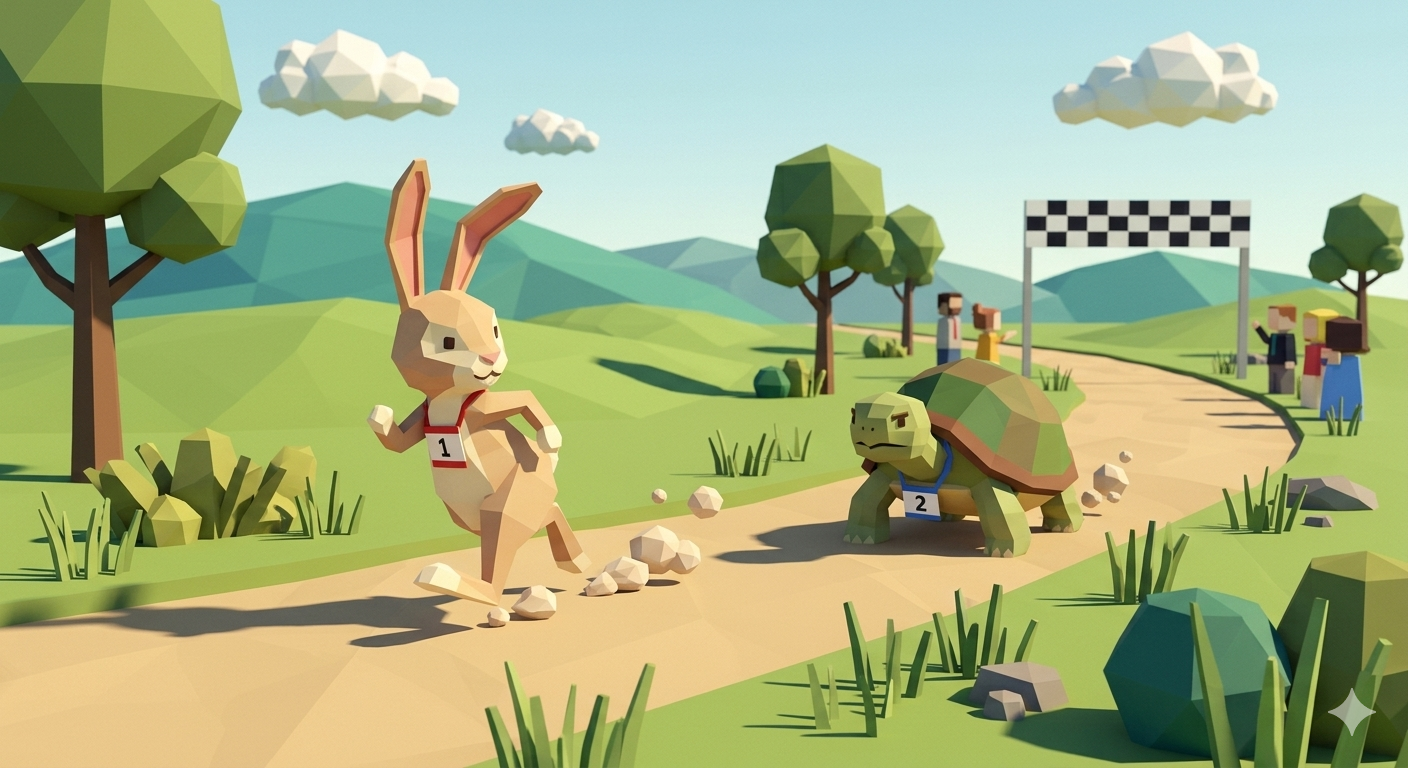
But what happens when every individual in a team or company gets 10x or 100x faster, at the same time?
What the research says
The most in-depth evidence is from software development (adoption is high, usage is measured).
A large study by GitHub Copilot found that the tool increased project-level code contributions by around 6%. But the actual coordination time for integrating that code rose by 8% because AI-assisted work generated more to review, update, and deploy.[^1]
A separate Harvard Business School study of 187,000 developers found the same shift in a different form. Once developers had AI, they spent 12% more time on solo coding and 24% less time on project management: the reviewing, the triaging, the handoffs. You know, all the boring work that actually holds a team together.[^2]
This all mirrors my own experience at a software start-up. Once developers started using AI tools more, the volume of code generated skyrocketed, but the main bottleneck to shipping more features still existed. The number of unreviewed pull requests (the code that was generated) also skyrocketed, creating long delays in actually releasing that new code in the product.
Individual output climbs. The practices and coordination among the team gets thin.
Why faster individuals isn’t enough
The assumption behind most AI transformations is simple: if everyone gets faster individually, the team gets better and faster automatically.
That's not how teams work. It never has been.
Great teamwork comes from clear goals, shared practices, mutual understanding, clear coordination, and calibrated expectations. And now there's growing evidence that AI actively pulls against those things.
A pair of randomised studies from Northeastern University found that simply exposing a team to AI changed how its people related to one another. Their shared language, their attention, their mental models, and their social cohesion all shifted.
The researchers describe AI as an implicit "social forcefield". It doesn't just change how people work; it changes how they think and how they relate to each other.[^3]
You can see the everyday version of this without a study. When one person starts drafting documents or generating code 3-10 times faster, but nobody else knows that's happening, you get:
- Mismatched expectations about turnaround times
- Erosion of trust in the quality of AI-assisted work
- Invisible changes to who does what
- A widening gap between the team's most and least AI-fluent members
- Confused teammates who don’t know how to contribute
This is also why Microsoft framed its 2025 New Future of Work report around exactly this dynamic.
In 2024, their research was about individual productivity gains. The 2025 report names the next frontier plainly: collective productivity, how teams get better together. They’re just as clear about the catch: AI can bridge gaps of time, distance and scale, but only if it's built to support shared goals and the norms of collaboration.
New tools aren't enough. It takes new ways of working.[^4]
What actually moves the needle
The good news is that the research also points to what teams can do to actually improve their use of AI, while getting better and faster. It’s not more tools or training; it’s a **clear and aligned set of deliberate team practices. **
Teams that agree on how they'll use AI outperform teams that leave it to individuals.
Atlassian's Teamwork Lab ran a structured exercise where teams co-created explicit AI working agreements: shared norms for when and how AI gets used. Afterwards, 82% said it made the team more aligned, and 75% had discovered an AI use case they hadn't known about.[^5]
The value wasn't the document. It was the conversation that produced it.
Teams that use AI together, not just individually, get better results.
A five-month study of managers, published in Harvard Business Review, found that without intentional integration AI can quietly narrow participation and shift ownership away from the group.
The teams that avoided this did three things:
- They engaged AI as a team rather than as individuals
- They had it play different roles to sharpen discussion and understanding
- They kept ownership collective: shaping prompts together, debating the outputs together, and making decisions together.[^6]
The best practices come from the team, not the top.
Microsoft's research is blunt about this: some of the best ways to use AI come from the edge, not the centre.
Workers adopt AI more readily, and more usefully, when they help shape how it's used and when they feel safe enough to share what's working (I’m looking at you, leaders).[^4]
None of this is new. The secret to unlocking more from your Human-AI teams isn’t more tools and training, but good ol’ fashioned teams, coming together, deciding how they want to work and building the practice over time.
Footnotes
[1] Hoffmann, Boysel, Nagle, Peng & Xu, "The Impact of Generative AI on Collaborative Open-Source Software Development: Evidence from GitHub Copilot," 2024. https://arxiv.org/abs/2410.02091
[2] "Generative AI and the Nature of Work," Harvard Business School working paper, study of 187,000 open-source developers, 2026. https://www.hbs.edu/ris/Publication Files/25-021_491efe26-e444-4e02-b58e-f27300cde12f.pdf
[3] Riedl, Savage & Zvelebilova, "Cognitive Spillover in Human-AI Teams," ACM Transactions on Computer-Human Interaction, 2026. https://arxiv.org/abs/2407.17489
[4] Butler, Jaffe, Janßen et al. (Eds.), Microsoft New Future of Work Report 2025, Microsoft Research, MSR-TR-2025-58, December 2025. https://aka.ms/nfw2025
[5] "How co-creating AI working agreements drives confidence and clarity," Atlassian Teamwork Lab, 2026. https://www.atlassian.com/blog/teamwork/ai-working-agreements
[6] Rosani, Farri, Trabucchi & Buganza, "It's Hard to Use AI as a Team. These 3 Practices Can Help," Harvard Business Review, May 2026. https://hbr.org/2026/05/its-hard-to-use-ai-as-a-team-these-3-practices-can-help